Guide
How to Choose a Rug
Rugs are the easiest thing in a room to get wrong, and it is nearly always the size. The measurements that work, in centimetres, room by room.
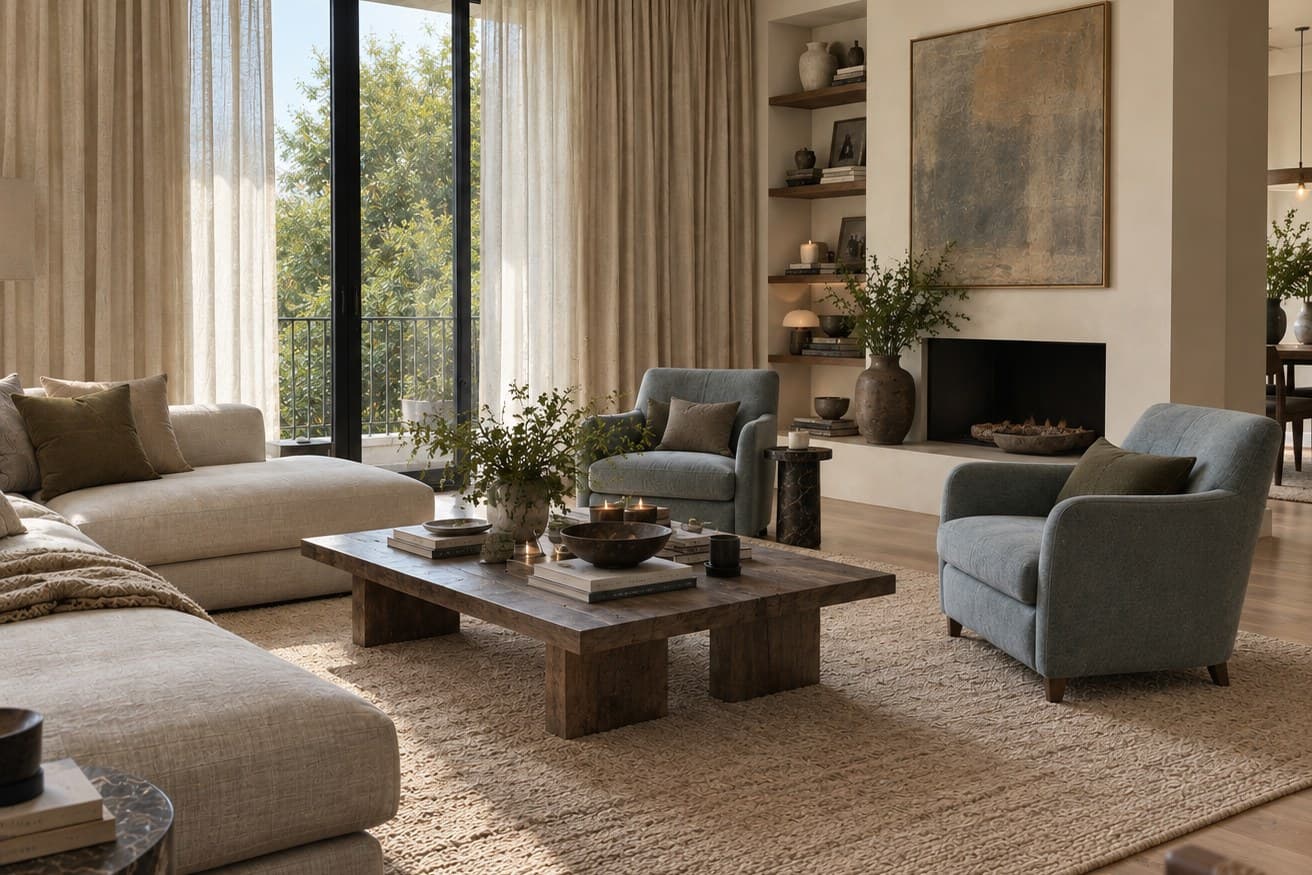
A rug is the one purchase in a room where being sensible about money usually produces the worst result. Rugs are priced by area, so the temptation at every step is to go one size down, and a rug that is one size too small does not look like a smaller version of the right rug. It looks like a mistake.
So this is a guide to getting the size right first. Everything else, colour, material, pile, pattern, is easier, and none of it rescues a rug that is 40cm too short.
Why small rugs fail
A rug’s job is to draw a line around a group of furniture and say: this lot belongs together. When it is big enough to touch every piece in the group, the sofa, the chairs and the table read as one arrangement. When it is not, each piece floats separately on the floor and the rug becomes a fourth object in the middle, unrelated to any of them.
Two other things happen, both of them the opposite of what you would expect.
- A small rug makes a room look smaller. A large rug carries the eye out towards the walls. A small one stops it short in the middle, and the floor around it reads as leftover space.
- A small rug makes good furniture look cheap. A sofa standing on bare floor beside an island of carpet has nothing anchoring it. It is the same effect as a picture hung too high.
If the budget genuinely will not stretch, the answer is not a smaller rug. It is a large, plain, inexpensive natural fibre rug, jute or sisal or seagrass, used as a base, with a smaller good one layered on top later.
The living room, in numbers
Start by laying the plan out on the floor with masking tape, or an old bedsheet, before you buy anything. Twenty minutes of tape settles arguments that a photograph never will.
There are three layouts, in descending order of how well they work.
- All legs on. Every piece in the seating group stands entirely on the rug, with the rug continuing 15 to 20cm beyond the back legs. The most generous version, and it wants a big floor and a big budget.
- Front legs on. The rug runs under the front legs of the sofa and of every chair in the group, with the back legs on the floor. This is the standard solution and it looks entirely deliberate, provided the front legs are properly on, with at least 10 to 15cm of rug behind them rather than balanced on the edge.
- Coffee table only. The rug sits under the coffee table and touches nothing else. This is the failure mode, and it is what most 160x230cm rugs are doing in most living rooms.
Whichever you use, apply it consistently. If the sofa has its front legs on, the armchairs do too. A group where one chair is fully on and another is fully off reads as an accident, because it is.
Around the sofa specifically. The rug should be wider than the sofa, with 20 to 25cm of it showing past each arm, and deep enough to pass under the coffee table and reach the seats opposite. If it stops before the front legs of the chairs across from the sofa, the group is not tied together.
At the edges. Leave a margin of visible floor between the rug and the walls. 20 to 40cm looks framed and deliberate. A rug that runs up to the skirting reads as badly fitted carpet. In a small room, err towards the larger rug and the smaller margin.
Sizes that actually get used. In a typical European living room with a three seat sofa:
- 160x230cm is a bedroom or hallway rug that has wandered into the wrong room. Too small for almost any living room group.
- 200x300cm is the realistic minimum. It works with a three seat sofa front legs on, in a room of around 3.5 x 4.5m.
- 250x350cm is the size most rooms want, and the one people wish they had bought.
- 300x400cm and up is for open plan spaces, or a big room where the seating sits away from the walls.
Dining rooms
Only one rule matters here, and it is about chairs: the rug must extend at least 60cm past the table on every side, so that a chair pushed back to let somebody out is still completely on the rug. With heavy dining chairs, or wide ones with arms, make it 75cm.
The test is not how it looks with the table laid. It is what happens when six people stand up at once. A chair leg dropping off the edge catches, scuffs the binding and eventually tears it.
For a table seating four to six that usually means 200x300cm, and for six to eight 250x350cm. Low pile only. A deep pile is miserable to pull a chair across and impossible to get crumbs out of.
Bedrooms
The bed covers most of the rug, so what you are really buying is the part you put your feet on. Extend the rug 50 to 70cm past the bed on the two sides and the foot, starting it either under the whole bed or from just below the bedside tables.
Three arrangements work:
- Rug under the whole bed, running past it on three sides. Cleanest, and it needs the most rug: 240x340cm for a 160cm bed, or 200x300cm at a squeeze.
- Rug under the lower two thirds, starting below the bedside tables. The same effect from a smaller rug, because the top of it was never going to be seen.
- Two runners, one either side of the bed, with an optional third at the foot. The cheap route, and it looks intentional in a room where one large rug would not fit.
Then, and only then, the material
- Wool. The default, for good reasons: springy, hard wearing, takes dye beautifully, resists crushing and is naturally a little stain resistant. It sheds for the first few months. Buy it if you can.
- Jute, sisal, seagrass. Cheap, enormously textured, and the fastest way to warm up a hard floor. Scratchy underfoot, and they mark permanently when something wet goes on them. Best as the base layer of a layered pair.
- Cotton flatweave. Light, washable, inexpensive, and it flattens. Fine in a bedroom or a hallway, thin-feeling under heavy furniture.
- Viscose. Sold as art silk, and the sheen is genuinely lovely. It is also the material most likely to be ruined by a dropped glass of water, which leaves a permanent mark. Avoid it in a dining room or anywhere with a dog.
- Polypropylene. Practical, cheap, and it reads flat and slightly plasticky under lamplight, which is the one lighting condition this whole look depends on.
In a dark, layered room an antique or faded pattern hides an extraordinary amount of daily life, and a plain pale rug shows every mark you can imagine. That is worth more than any argument about colour.
Before you buy
Tape the outline out on the floor and live with it for a day. Check that the rug will reach under the front legs of everything in the group, check the margin to the walls, and if the answer is between two sizes, take the larger one. Nobody has ever stood in a finished room and complained that the rug was too big.
Common questions
- What size rug do I need for a living room?
- Measure the seating group, not the room. The rug wants to run 20 to 25cm wider than the sofa at each end and reach far enough forward that the front legs of every seat in the group stand on it. For a standard three-seat sofa with a chair opposite, that is 200x300cm at the absolute minimum and usually 250x350cm.
- Do all four legs of the sofa have to be on the rug?
- No, but the front two do. All legs on is the most generous version and needs a big rug. Front legs on is the layout most rooms can actually afford, and it works as long as at least 10 to 15cm of rug sits under the front legs rather than stopping at the toes. Nothing on the rug at all is the arrangement that makes a room look unfinished.
- What size rug goes under a dining table?
- One that extends at least 60cm past the table on every side, so a chair stays fully on the rug when it is pushed back. With heavy or wide chairs, make it 75cm. If a chair leg catches the edge every time somebody stands up, the rug is too small and it will never stop being annoying.
- Is a jute rug comfortable?
- Not especially. Jute and sisal are cheap, hard wearing and full of texture, and they are scratchy underfoot and difficult to clean once something is spilled on them. They are at their best as a big base layer with a softer wool or vintage rug laid on top, which is also the cheapest way to fill a large floor.
- Do I need a rug pad?
- On a hard floor, yes. It stops the rug creeping, stops the corners curling, adds a little softness and takes the abrasion that would otherwise wear out the rug's own backing. Buy it about 3cm smaller than the rug on each side so it does not show.