Guide
How to Light a Room
Why one ceiling light is never enough, what height each kind of lamp wants to sit at, and what the numbers on the bulb box actually mean.
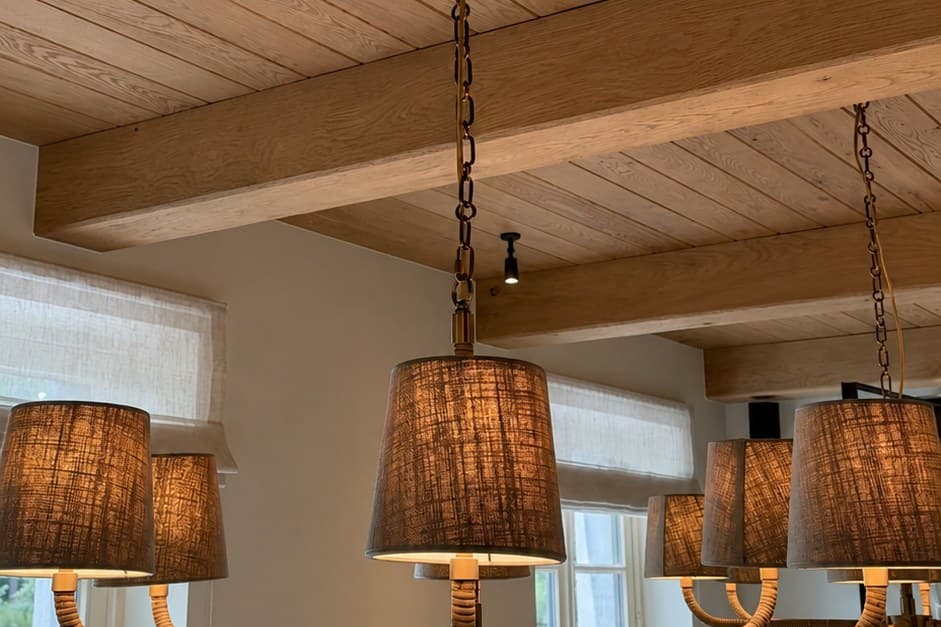
Lighting is the difference between a room that looks like the photograph and a room that looks like a photograph of somebody else’s house. It is also the cheapest part of the whole look to get right: a €40 lamp in the correct place does more for a space than a €400 chair in the wrong one.
The short version is several small lights, low down, all of them warm, all of them on a dimmer, and never the ceiling light on its own.
Why the big light is the problem
A single fitting in the middle of the ceiling lights a room from one point, directly above. It flattens everything: no shadows, no depth, a cold pool in the middle and dark corners around it. Every hotel bar and restaurant you have ever liked the look of is doing the opposite, with lots of small sources, most of them below head height, each one lighting a small area well.
The trade splits the job three ways, and a room wants all three:
- Ambient is the general level that lets you move around safely. A pendant, a ceiling fitting, or in a well-planned room, several lamps adding up.
- Task is the bright, aimed light you read, cook or work by. A floor lamp beside a chair, a lamp at a desk, a strip under a kitchen cupboard.
- Accent is the light with no practical job at all: a picture light, a small lamp on a bookshelf, something washing a textured wall. It is what makes a room look considered rather than merely lit.
Work in heights, not in fittings
The useful question is not “how many lamps” but “at how many different heights is there light in this room”. Aim for four bands.
- Ceiling, 240cm and up. A pendant, or nothing. In a low room a flush fitting on a dimmer, used at 20 per cent, is a better ambient wash than a pendant hanging into your eyeline.
- Above eye level, 150 to 165cm. Wall lights. These are the ones most people skip and the single biggest upgrade available, because they light the wall rather than the floor and make the room read taller. Hard wired ideally, though plug-in versions are a legitimate route in a rental.
- Seated eye level, 100 to 130cm. Table lamps on a console, a side table or a sideboard, and the shade of a floor lamp. This is where most of the warmth in a room comes from.
- Low, under 60cm. A small lamp on the floor behind a plant or at the bottom of a bookcase. Nobody notices it and everybody notices the room.
Heights worth measuring
- Table lamp. Total height around 70 to 80cm on a side table of normal height, which puts the bottom of the shade near eye level when you are sitting down. If you can see the bulb from the sofa, the shade is too high or too small.
- Floor lamp for reading. Bottom of the shade about 100 to 105cm from the floor, which is seated eye level again, and placed just behind and to the side of the chair rather than in front of it.
- Pendant over a dining table. 75 to 90cm from the table top to the bottom of the shade, centred on the table rather than on the room. If the table moves, the pendant has to move with it, and a ceiling hook plus a long flex is the cheap way to make that possible.
- Wall lights. 150 to 165cm to the centre of the fitting in living spaces, 100 to 120cm beside a bed.
The numbers on the box
Three numbers matter, and the one people look at first, watts, is not one of them. Watts measures what a bulb costs to run, not what it gives you.
Lumens is brightness. An old 60W bulb is about 800 lumens. For the sort of light I am after, individual lamps in the 200 to 500 lumen range are right; save 700 lumens and up for a task light you genuinely read by. If a room feels like an interrogation, the fix is usually fewer lumens in more places, not a dimmer on one enormous fitting.
Kelvin is colour. This is the one to get right, and it runs opposite to instinct: the lower the Kelvin number, the warmer the light.
| Kelvin | What it looks like | Where it belongs |
|---|---|---|
| 1800 to 2200K | Candle, filament amber | Accent lamps, bars, late evening |
| 2700K | Warm white, the classic domestic bulb | Almost everywhere at home |
| 3000K | Warm but crisper, slightly yellow white | Kitchens, bathrooms, a workshop |
| 4000K | Neutral, faintly clinical | Offices, garages |
| 5000K and up | Daylight, blue | Nowhere you want to relax |
For this look, buy 2700K and stop thinking about it. If you want a room to drop into evening properly, look for dim to warm LEDs, which fall to around 1800 to 2200K as you dim them, the way a filament bulb did. They cost more and need a compatible dimmer, and in a dining room they are worth it.
CRI is honesty. Colour Rendering Index, 0 to 100, is how accurately a light shows colour. Below 80 and a warm olive wall goes grey and the wood goes dead. Look for CRI 90 or better. It is printed on good bulbs and quietly left off cheap ones, which tells you what you need to know.
Dimmers are not optional
Every light in a room where people sit should be dimmable, because the right brightness at eight in the evening is not the right brightness at eight in the morning. Two cheap routes if rewiring is out: dimmable smart bulbs in existing fittings, and in-line dimmer switches on lamp flexes.
Check compatibility. An LED on a dimmer built for filament bulbs flickers, buzzes or refuses to go below half. The bulb packaging says whether it is dimmable and the dimmer’s instructions say what minimum load it needs.
Shades, and what they do to the light
- Opaque or lined shades throw light up and down in two cones and leave the middle of the room soft. This is the whole effect in one object. Pleated card and lined linen both do it.
- Woven and open shades, rattan, cane, perforated metal, scatter a patterned light across the ceiling and walls. Wonderful over a table, useless as a reading light.
- Bare bulbs only work at very low output. A clear filament bulb at 400 lumens in an open fitting is a glare source at head height, and it is why a lot of otherwise good rooms are uncomfortable to sit in.
Where to start
Turn the ceiling light off for a week and add, in this order: a floor lamp beside the chair you actually sit in, a table lamp on the other side of the room, a third small lamp somewhere low, and 2700K dimmable bulbs in all of them. That is usually the whole job.
The pieces
3 pieces
- Image
Thorne Antiqued Brass Floor Lamp (affiliate link to Aldermoor & Co., opens in a new tab)
€520at Aldermoor & Co.
An arched floor lamp reaches over a sofa, so the light lands where you read rather than behind you.
Ships to Ireland and the UK, not the US or Australia
- Image
Wren Brass Table Lamp (affiliate link to Halden Home, opens in a new tab)
€89at Halden Home
Small, warm, and the cheapest way to add a fourth light source to a room.
Ships to Ireland, the UK and Australia, not the US
- Image
Aldis Rattan Pendant Shade (affiliate link to Halden Home, opens in a new tab)
€115at Halden Home
A woven shade throws a patterned light onto the ceiling, which is half the reason to hang one.
Ships to Ireland, the UK and Australia, not the US
Common questions
- How many lights does one room need?
- Three as a floor, five in a living room you actually sit in, and none of them the ceiling light on its own. The point is not brightness. It is that light coming from several places at low level kills the flat, shadowless look a single overhead fitting gives you.
- Does a higher Kelvin number mean warmer light?
- No, it is the other way round, which catches almost everybody out. Low Kelvin is warm and orange, high Kelvin is cold and blue. 2200K is candlelight, 2700K is the warm white you want almost everywhere at home, 4000K is an office and 6500K is daylight. If a bulb is labelled cool white or daylight, it is the wrong bulb for a living room.
- What is the right height for a wall light?
- Roughly 150 to 165cm from the floor to the middle of the fitting in a living room or hallway, so the bulb sits above standing eye level and you do not look into it. Beside a bed, drop it to about 100 to 120cm from the floor, measured so the bottom of the shade clears your shoulder when you sit up to read.
- How high should a pendant hang over a dining table?
- 75 to 90cm between the table top and the bottom of the shade. Lower than that and you cannot see the person opposite. Higher and the pool of light spreads out and stops being the thing that holds the table together.
- Are smart bulbs worth it?
- For colour changing, no. For dimming without rewiring, yes. A warm white smart bulb in an existing fitting is the cheapest way to get a dimmer into a rented flat. Check that it dims to a genuinely low level; plenty of them bottom out around 10 per cent and flicker below it.